

Define what your New York attorney search must establish
An NY attorney search should produce a short list of attorneys whose practice area, location, and stated services appear relevant, not an instant conclusion that any attorney is suitable for your matter. A directory listing, referral, profile, or review can help you identify whom to investigate. None of those items, standing alone, establishes current New York registration, disciplinary history, or the fit between an attorney and your specific circumstances.
Your search should answer four separate questions:
- Does the attorney appear to handle the type of legal problem you need to discuss?
- Does the attorney appear connected to the New York location or other jurisdiction that matters to your situation?
- What public information can you independently check about registration and discipline?
- What should you ask during an initial contact before deciding whether to continue the conversation?
Keeping those questions separate prevents a common error: treating visibility in a directory as proof of authorization or suitability. A profile can be a discovery tool. A consultation can help you explain the facts and ask focused questions. Neither substitutes for checking authoritative information or making your own decision about whom to contact.
New York-specific verification also requires care because the New York State Bar Association is not the state’s official attorney licensing or registration authority. The New York Office of Court Administration is the official licensing and registration unit. New York’s Unified Court System provides a free public attorney search by name. Use those distinctions when you organize your search, especially after an accident, employment dispute, family matter, business disagreement, or other event that makes timing and location significant.
Build a New York attorney verification file before searching
Before you compare names, build a New York attorney verification file. Its purpose is not to decide which attorney is suitable. It is to preserve the facts needed to match a candidate’s identity and stated practice to the right New York questions, then carry unanswered points into an official check and consultation. Start with facts you can describe, not a legal conclusion you are not yet prepared to defend.
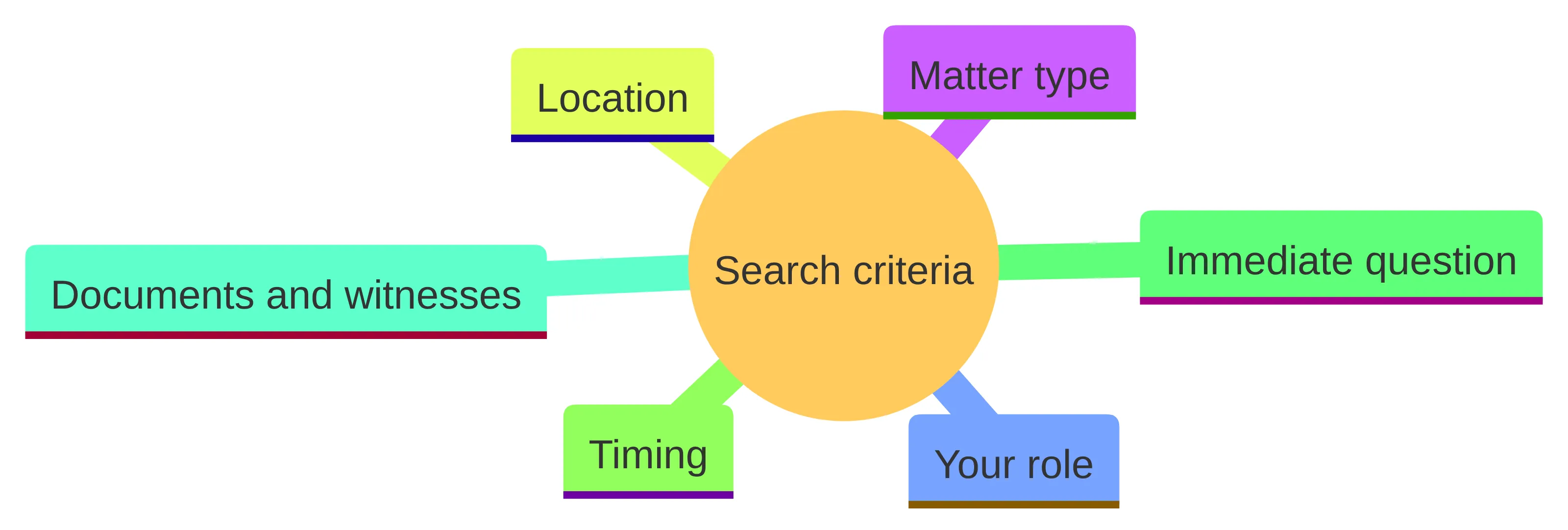
Write down the following:
- Matter type. Describe the event or dispute in plain language: a collision, a fall, an employment problem, a contract disagreement, a family-law issue, or another concrete subject.
- Your role. State whether you were injured, accused, sued, threatened with a claim, asked to sign an agreement, or seeking advice before taking action.
- Location. Record where the relevant event happened, where the opposing person or business is located, and where any court, agency, contract, or workplace connection may exist.
- Timing. List the event date, later communications, notices, appointments, filings, deadlines shown on documents, and any upcoming hearing or response date.
- Immediate question. Reduce your purpose to one sentence, such as whether to respond to a demand, how to preserve a claim, or how to understand an agreement before signing it.
- Documents and witnesses. Identify the records you have and the people who may know what happened without sending a large package before an attorney tells you what is useful.
Search terms should create a candidate queue, not a conclusion. A personal-injury search might distinguish a vehicle collision from a premises incident or a workplace injury. A business search might distinguish contract review from litigation. A family-law search might distinguish a pending proceeding from a request for advice before filing. Keep the search wording beside each candidate’s exact name so you can later compare the stated practice and location with the correct public record. Specific terms help you investigate a practice area without assuming that a category label proves experience with your exact issue.
Location deserves its own line because it helps both candidate matching and consultation preparation. A matter involving New York may also involve another state, such as an accident connected to Austin, Abilene, Brownsville, Beaumont, or the Texas Hill Country. That connection does not establish which attorney can handle the matter. It tells you to preserve the multi-state feature as an unresolved question and avoid relying on a location label alone.
Add a short “what I need to verify” line to your notes alongside the decision you need help understanding. For example, you may need to verify which person a profile refers to, whether the stated location fits the matter, or what remains unanswered before a consultation. This keeps the first conversation centered on a concrete question instead of an unfocused account of everything that has happened.
Your initial note should be short enough to read aloud and precise enough to match against a candidate’s information. If you cannot explain the event, your role, the location, and the question in a few sentences, spend time organizing those facts before drawing conclusions from search results or treating a name as a verified option.
Use discovery sources only to create a verification queue
Discovery sources are the lead stage of a New York attorney search, not the verification stage. A New York attorney-search guide published May 28, 2026 identifies bar referral services, local bar associations, online legal directories, and personal referrals as common starting points for locating attorneys in New York. Use those routes to assemble names and source context, then use the candidate’s exact identity for the separate New York registration and disciplinary-information questions.
Use each source for a defined task:
- Online directories: Assemble an initial set of names by practice area or location when the directory offers those filters. Preserve the exact name and the wording that produced the result.
- Bar referral services: Request a guided introduction through a process that may ask about your county, legal category, and matter. Record the referral as an introduction, not as a registration or suitability finding.
- Local bar associations: Look for a geographically relevant starting point when your matter depends on a particular New York community or court area, while keeping the source separate from the state’s licensing authority.
- Personal referrals: Ask a trusted person what the attorney’s communication and work process were like, while remembering that another person’s matter may differ from yours.
- Attorney profiles and websites: Gather the attorney’s stated practice areas, locations, consultation information, and contact route for later comparison.
- New York’s Unified Court System name search: Use the candidate’s exact name to locate the public attorney record and keep that result separate from directory or referral information.
No discovery source answers every question. A personal referral may tell you something about communication, but it does not establish current registration or resolve whether the attorney handles your matter. A directory may make comparison easier, but it may present information supplied for listing purposes. A referral service may have its own screening or intake process, but the service’s role and limits still matter. The source tells you how the name was found; it does not replace the New York record checks.
Record the source and the verification status of every name. Note whether the name came from a profile, a referral, a personal recommendation, or your own search, then leave a separate place for the name-search result, registration wording, and disciplinary-information question. This prevents an attorney’s marketing description from blending with an independent public record and makes unresolved points visible.
Use more than one discovery route when the matter is significant or the first list is thin, but do not treat a larger list as progress by itself. The purpose is to create a small set of candidates whose identities, stated practice, locations, and contact information you can examine before you rely on any profile or referral.
Match each candidate’s identity to the New York record
A New York attorney search should answer a narrower question than “Which lawyer looks like a fit?” It should first establish whether the public information you found refers to the same person whose New York registration and disciplinary questions you intend to investigate. Practice area, location, profiles, reviews, referrals, and consultation details can help identify candidates, but they belong in a different part of the file from the public record check.
Create a verification file for each candidate with three distinct headings: identity, registration, and disciplinary information. Under identity, copy the attorney’s exact name as displayed, along with the firm or office details and the practice-area and location descriptions that led you to the candidate. These details are not conclusions about suitability. They are comparison points that help prevent a search result for one person from being attached to another person with a similar name.
Use a public New York attorney-by-name search to compare the candidate’s exact name with the corresponding attorney record. Check the spelling, any available firm or location information, and the registration details shown for the matched person. If the name does not match cleanly, keep the identity question open rather than treating a similar result as confirmation. A profile that lists several offices, broad geographic coverage, or several practice areas may still leave the identity or jurisdiction question unresolved.
Registration is a separate question from the wording used in a profile. New York attorneys generally must register biennially and pay the required registration fee unless they certify retirement from active practice. That general requirement helps explain why registration deserves its own entry in the file, but it does not turn a profile, referral, or search filter into proof about a particular attorney. Record what the New York attorney record shows and keep any uncertainty attached to the individual name you checked.
Disciplinary information should receive its own heading rather than being folded into a review score or profile description. A disciplinary history report from the Third Judicial Department can provide an official record of determined professional-misconduct matters and the attorney’s current registration status with the Office of Court Administration Attorney Services. Its connection to the Third Judicial Department matters: do not present that report as a complete answer about every possible jurisdiction or every question a person may have about an attorney.
A New York disciplinary-history letter is also a distinct item. It indicates an attorney’s registration status and disciplinary history, or the lack of disciplinary history, but the subject attorney—not another requester—may obtain it. A reader who cannot obtain that letter should not treat its absence from their own file as a disciplinary conclusion. Instead, note the limitation and raise the question with the attorney or another appropriate New York resource.
Discovery information has a supporting role in this process. Online legal directories may let readers filter listings by practice area and location. Those filters can surface names for investigation, but they do not establish authorization, experience with a reader’s facts, availability, or suitability. Profiles can supply questions about the type of matter handled, the locations served, and the consultation process. Reviews can describe client experiences, while fee or consultation information can help a reader prepare practical questions. None of those items replaces the identity and registration entries in the verification file.
Referral services should likewise remain separate from licensing information. The New York State Bar Association’s referral process asks for the relevant county and law category, gathers information about the matter, and is for attorneys for hire rather than pro bono services. It states that referrals are free and consultations cost $35 for 30 minutes. The New York State Bar Association is not New York’s official attorney licensing or registration authority, so a referral can be a way to seek an introduction without serving as the registration check itself.
When reviewing a candidate, write down the unresolved question instead of converting it into a label. For example, a profile may prompt the question whether the attorney handles this type of matter in the county connected to the facts. A name match may prompt the question whether the registration details belong to the same person. A disciplinary entry may prompt a question about its department, date, or scope. This format keeps the file useful without asserting that an attorney is qualified or appropriate for the reader.
Before contacting or consulting an attorney, prepare a concise description of the legal matter, the relevant New York location, the dates or events that matter, and the specific points that remain unclear. Bring the identity, registration, and disciplinary questions separately. Ask about the attorney’s handling of the relevant type of matter, the location connected to the facts, the consultation terms, and any information the attorney needs to assess whether a discussion is appropriate. Do not treat a consultation invitation, a referral, a review, or a profile match as a legal assessment or a guaranteed result.
The practical outcome of this method is a candidate record with its limits visible: the person is identified as far as the available information permits, the New York registration question is recorded separately, and any disciplinary information is described within its stated department and access limits. Only then can the reader decide whether to investigate further or make contact, without confusing candidate discovery with independent New York verification.
Separate profile signals from public verification
Attorney profiles and client reviews are discovery layers that can supply questions for the New York verification file. They should not become a substitute for the public registration or disciplinary-information checks. A profile generally presents the attorney’s own description of practice areas, locations, services, or background. A review presents another person’s account, often without enough context to show whether the matter resembles yours.
Compare candidates using the same questions:
| Information layer | What to record | What the point cannot establish |
|---|---|---|
| Candidate identity | The exact name, spelling, initials, and source used to find the person | That a matching name is the same person without comparing the record |
| Practice area | The exact subject and subtopic named in the profile | That the attorney handles your specific facts or procedural stage |
| Location | The New York county, office, or geographic area identified | That the attorney can address every jurisdiction connected to your matter |
| Matter stage | Whether the profile or consultation information refers to advice, negotiation, or litigation | That the attorney will accept your matter or has capacity for it |
| Reviews | Repeated comments about communication, responsiveness, or clarity | That the reviewer’s result or experience will be yours |
| Consultation information | Stated fee, duration, format, and contact route | That the consultation will resolve your legal question |
| New York record | The name-search result, registration wording, date, and disciplinary-information question | That the record alone establishes suitability |
Reviews are most useful after you have separated the candidate’s identity from the reviewer’s account. If several reviews mention delayed communication, ask how messages are handled and who will be your contact. If reviews discuss a result, ask what part of the representation the result describes rather than assuming the same outcome is available to you. Do not treat a favorable review as proof of legal quality or a negative review as a complete account of the attorney’s work.
New York’s cited attorney-advertising rule addresses consultation fees, contingent-fee rates in civil matters with required disclosures, hourly rates, and fixed fees for specified services. The same rule prohibits a client endorsement or testimonial about a matter that is still pending and requires disclosure when an endorsement or testimonial is paid. Those rules give you a reason to read testimonials with context and ask how a fee statement applies to your proposed consultation; they do not decide whether an attorney suits your matter.
A comparison sheet should preserve the boundaries between information layers. Use labels such as “profile states,” “review mentions,” “name-search result,” “registration wording,” “disciplinary question,” and “question for consultation.” Those labels keep marketing information, personal impressions, public records, and your own unanswered questions from collapsing into one unsupported judgment.
Keep referral services separate from official licensing records
Referral services and official licensing records answer different questions. A referral service can help you locate an attorney or begin a consultation request. The New York State Bar Association itself is not New York’s official licensing authority.
The New York State Bar Association’s referral process asks for the relevant New York county and law category before gathering information about the matter to determine whether an attorney is available for consultation. That intake function helps route a request. It does not turn the referral into a licensing record or a conclusion about suitability.
Keep three labels separate in your notes:
- Discovery: Where you found the attorney or how the introduction began.
- Official status: What an appropriate New York court resource shows about registration.
- Suitability questions: What remains to be discussed about the matter, location, timing, communication, and fees.
This distinction matters when a profile, referral counselor, or bar resource uses terms such as screened, listed, referred, or available. Those terms may describe that service’s role, but they do not answer every question about current registration, disciplinary information, or whether the attorney should handle your matter.
Use a referral service when you want help forming an introduction or need a structured intake route. Then perform the licensing check separately. The referral helps you find a person to investigate; the official record addresses a different verification question.
Check New York registration through the court’s name search
Make the New York check an identity-and-registration step, not an inference from a directory profile or bar-association listing. Use the New York State Unified Court System’s name search to locate the candidate record.
Use the attorney’s exact name from the profile or referral, then compare the result with the information you recorded. Pay attention to:
- spelling, initials, and name variations;
- whether the record belongs to the person named in the profile or referral;
- the registration or status wording displayed in the result;
- any status wording that requires you to read the associated explanation rather than guess at its meaning;
- the date on which you performed the search;
- the difference between what the record states and what you still need to ask.
As of October 29, 2026, New York attorneys generally must register biennially and pay the required registration fee unless they certify retirement from active practice. That rule is a general New York registration requirement, not a conclusion about any particular attorney. Use the name-search result to locate the individual record, then keep its wording and date in your notes; a profile or referral remains a discovery source rather than a substitute for the check.
Save the official result or record the search date and the exact name used. If the name does not match, the result is unclear, or the status raises a question, do not convert uncertainty into an assumption. Ask the attorney about the discrepancy and use the appropriate official resource for clarification before relying on the profile.
The registration result answers one checkpoint, not the whole decision. It does not tell you whether the attorney handles your matter, has availability, communicates in the way you need, or offers terms you can accept. Keep practice-area, location, disciplinary-information, and consultation questions as separate entries rather than treating registration as a conclusion about suitability.
Treat disciplinary information as a separate question
Disciplinary information is a separate question from current registration. A registration search may help you examine status, but it should not be treated as a complete disciplinary-history review. The available New York materials also differ by court department and by who may request a particular record.
A disciplinary history report from the Third Judicial Department is an official record concerning professional-misconduct matters that the committee or Appellate Division reviewed and determined. The report can provide the attorney’s current registration status with the Office of Court Administration Attorney Services. That description is specific to the Third Judicial Department resource; do not present it as a single statewide report covering every New York attorney or every department.
A New York disciplinary-history letter indicates an attorney’s current registration status and disciplinary history, or the lack of disciplinary history, but the attorney who is the subject of the letter—not another requester—may obtain it. You therefore should not assume that you can order that letter yourself or that the absence of a letter in your file proves anything about the attorney.
When you investigate, separate three records in your notes:
- Registration: What the official New York search shows about the attorney’s status.
- Department-specific disciplinary information: What an official resource for the relevant Appellate Division department reports and what its scope is.
- Questions for the attorney: Any discrepancy, disclosure, or explanation that needs to be discussed directly.
Avoid broad conclusions from a search result you do not understand. If the matter is consequential or the record is difficult to interpret, write down the exact wording and ask a qualified legal professional how it affects your decision. This guide cannot determine what a particular entry means for your choice of counsel.
Record identity, registration, and disciplinary checks separately
Your verification ledger should distinguish the candidate’s identity, the New York record, and unresolved questions before you make contact. A simple record shows why each name remains under review, which source supports each point, and what still needs an answer.
Create one row for each candidate and use these columns:
- Candidate identity and source: Record where you found the attorney, the exact name shown, and any spelling or name variation.
- Matter connection: Note the practice area and the facts that appear relevant.
- Location connection: Record the New York county, community, office, or other jurisdiction described.
- Name-search result: Enter the search date and the wording returned for the person you intended to investigate.
- Registration point: Record what the New York record states and what its wording does not answer.
- Disciplinary-information question: Identify the relevant department or scope, including whether a Third Judicial Department report or a letter obtainable only by the subject attorney is the issue.
- Profile and review prompts: Copy only useful practice, contact, consultation, and communication details to ask about.
- Contact questions: List the questions that must be answered before you decide whether to proceed.
Use three labels for each entry:
- Recorded in a public or official source: A specific search result or identified record supports the point.
- Stated by the attorney or service: The point comes from a profile, advertisement, referral description, or consultation page.
- Unresolved: You have not yet obtained enough information to draw a conclusion.
The labels matter. “The profile lists personal injury” is different from “the attorney has agreed to evaluate my collision.” “The official search returned a name” is different from “the attorney is suitable for my dispute.” “A review describes prompt communication” is different from “the attorney will respond to me promptly.”
Remove a candidate when the public information clearly does not match your matter or location. Do not rank attorneys by a single review, a search-result position, a claimed result, or a profile adjective. Order your next checks instead: which identity needs confirmation, which registration wording needs interpretation, which disciplinary-information question has a defined scope, and which contact would answer the most significant unresolved point.
Before contacting anyone, mark the facts that could change the search: another state, a pending court date, a demand deadline, a signed agreement, or a conflict involving a party or witness. Put those items at the top of your questions. They deserve direct discussion rather than a conclusion drawn from a profile.
Prepare questions around verified and unresolved points
After the candidate’s identity and available New York record information are noted, prepare a consultation summary that puts the unresolved questions in view. It should give an attorney a usable starting point without burying the central question in an unorganized document package. Your summary is a communication aid, not a legal argument and not a substitute for advice about what to preserve or disclose.
Prepare a one- to two-page account with these parts:
- Candidate and purpose: Identify the attorney you are contacting, how you found the name, and the question you want to discuss.
- Opening sentence: State what happened, your role, and the legal question you want to discuss.
- Chronology: List the key dates in order, including the event, medical or business consequences, notices, calls, demands, filings, and upcoming dates.
- Location: Identify where the event occurred and any other state, county, court, workplace, contract, or property connection that may matter.
- People, organizations, and documents: List the parties, witnesses, insurers, employers, agencies, businesses, or attorneys involved and identify records such as contracts, correspondence, photographs, medical records, incident reports, court papers, or insurance communications.
- Record questions: Note the registration wording you found, any unresolved identity issue, and any disciplinary-information question that needs discussion.
- Current position and questions: State what has already happened, what you have not done, and the two or three decisions you need help understanding.
Separate fact from assumption and separate the public record from your interpretation of it. “The property manager emailed me on June 3” is a fact you can document. “The property owner is liable” is a legal conclusion that should remain a question unless an attorney explains it. “The other driver caused the crash” may be your view; identify the observations, report, photographs, or witnesses that support it without presenting the conclusion as established. Likewise, preserve the wording of a registration result without turning it into a conclusion about suitability.
Bring a document index rather than sending every file at once. Mark missing records, disputed facts, and uncertain dates. If another state is involved, put that fact near the top rather than leaving it in an attachment. A matter involving New York and Texas, including a connection to Austin, Abilene, Brownsville, Beaumont, or the Texas Hill Country, may require a focused jurisdiction question before you rely on a general search result.
Separate the information you can state confidently from the questions that require advice. For example, you can identify the date of a notice without deciding whether it creates a legal deadline. You can describe an injury, payment, conversation, or contract term without deciding what legal consequence follows. You can also report what a profile says and what the New York record displays without deciding whether the attorney is suitable. This structure gives the consultation a clear starting point.
Before sharing sensitive information through an online form or email, understand who will receive it and what the contact is intended to do. Share enough to identify the consultation question, then follow the attorney’s instructions about additional material.
Use referral services when a guided introduction helps
A referral service can be useful when you want a structured introduction instead of building the entire candidate list yourself. The service should still be treated as one discovery route within a larger search-and-verification process.
The New York State Bar Association’s referral process asks for the New York county and law category, then gathers information about the matter to determine whether an attorney is available for consultation. The service is for attorneys for hire and does not offer pro bono services. As of October 29, 2026, the New York State Bar Association states that referrals are free and consultations cost $35 for 30 minutes.
The New York City Bar’s referral service accepts requests by phone or online, describes its information handling as confidential to the fullest extent possible under the law, and refers people to a screened lawyer or another appropriate resource. As of October 29, 2026, the New York City Bar states that initial consultations are $35 or free depending on the case type and last up to 30 minutes.
A guided introduction may fit your situation when:
- you know the general legal subject but do not know which practice-area terms to use;
- your county or location is central to the search;
- you want to discuss the matter with a referral counselor before contacting an attorney directly;
- you need to understand whether the service offers paid attorney consultations or another resource.
Prepare the same concise matter summary for a referral service that you would prepare for an attorney. Give the county, law category, event, timing, and immediate question accurately. Ask what the referral covers, whether the attorney is available for a consultation, what fee applies, and what information you should bring.
A referral service does not eliminate the remaining checks. Keep the referral source in your records, compare the introduced attorney with other candidates, check the official New York registration resource, and ask focused questions before deciding whether to proceed.
Use Lawyers.co as a candidate-intake layer, not a status check
Lawyers.co can be one part of the candidate-intake stage when you want to examine attorney profiles, read client reviews, and schedule consultations. We let clients review lawyer profiles, read client reviews, and schedule consultations with lawyers. Those functions help you collect profile and contact information; they do not establish that a particular attorney is suitable, available, currently registered, or likely to produce a particular result. Keep the New York identity, registration, and disciplinary-information checks separate.
Use Lawyers.co after you have defined the matter and location. Record the practice-area wording, location information, consultation details, and review themes that appear relevant. Turn each useful profile signal into a question rather than a conclusion:
- If the profile names a personal-injury practice, ask whether the attorney evaluates the kind of accident and injury involved in your matter.
- If the profile identifies a New York location, ask how the attorney handles the county or other jurisdiction connected to your facts.
- If reviews describe communication, ask who will communicate with you and how often you should expect updates.
- If the profile presents consultation information, ask what the consultation covers and what fee or time limit applies.
- If the profile or review describes a result, ask what facts and stage of representation produced that result rather than treating it as a forecast.
Our process includes describing your case, getting matched with a lawyer, and choosing a lawyer. We also have an expert intake team that reviews legal cases to understand specific needs. This is a structured contact step, not a New York registration or disciplinary-history determination. A match is not a legal determination and does not establish acceptance, suitability, or an outcome.
Keep the New York record questions outside the profile review. Use the New York court and licensing information described above for registration questions, and treat disciplinary information as a separate inquiry with its stated department or access limits. Then bring your concise summary and unresolved questions to the consultation. Lawyers.co can help you review possible candidates and prepare that contact; you remain responsible for deciding which candidate to investigate and whether to continue.
Take the next defensible step toward a consultation
Your next defensible step is to complete one candidate record rather than make a broad judgment from a search result. Write the matter, location, timing, and consultation question; record how you found the attorney; compare the profile and reviews as prompts; and check the attorney’s name through New York’s official court resources. The Unified Court System provides a free public attorney search by name, and the Office of Court Administration is New York’s official licensing and registration unit.
After that check, prepare your short chronology, document index, and unanswered questions. Contact the candidate through the available route and ask about the matter connection, location, consultation scope, fees, timing, and information to provide. A qualified professional must decide individual suitability after considering your circumstances; this guide cannot make that decision for you.
What should you verify before contacting a New York attorney?
What should I establish before starting my New York attorney search?
Before beginning your search, clarify the type of legal problem you need to discuss, the relevant location, and what public information you can check about an attorney's registration and disciplinary history.
How can I narrow down my search for a New York attorney?
You can narrow your search by defining specific criteria such as the type of legal matter, your role in the situation, the location of the event, and any relevant timing or documentation.
What resources can I use to find qualified attorneys in New York?
Common resources include the New York State Bar's lawyer referral service, local bar associations, online legal directories, and personal referrals.
What should I ask during an initial consultation with an attorney?
During an initial consultation, ask about the attorney's experience with your specific legal issue, their approach to communication, fees, and any other questions relevant to your case.
What is the role of referral services in finding an attorney?
Referral services can help you locate an attorney by guiding you through a structured process, but they do not replace the need for independent verification of an attorney's qualifications.
How can Lawyers.co assist in my attorney search?
Lawyers.co allows you to review attorney profiles, read client reviews, and schedule consultations, helping you organize your search and prepare for contact with potential attorneys.
Sources
- Which Find A Lawyer New York Method Fits Your Legal Needs? — www.daeryunlaw.com, 2026-05-28
- Appellate Division - Second Judicial Department — www.nycourts.gov
- Sections 1200.6(c)(1), (3), (5), (7) and (g)( ... — www.nycourts.gov
- Public Resources - New York State Bar Association — nysba.org
- New York State Bar Association Lawyer Referral Service - New York State Bar Association — nysba.org
- Legal Professional | New York Courts — www.nycourts.gov
- Disciplinary History Reports — www.nycourts.gov
- Attorney Verification - New York State Bar Association — nysba.org
- Lawyer Referral Service & Legal Info in New York | NYC Bar — www.nycbar.org
- Appellate Division - Second Judicial Department — www.nycourts.gov