

Start with jurisdiction and the consultation question
Finding a nearby legal firm is not primarily a distance decision. For a healthcare administrator, the first screen is whether a consultation can address the operational question in the relevant state or states and whether the proposed engagement fits the work. A firm near a facility in Austin, Abilene, Brownsville, Beaumont, or the Texas Hill Country may still need to explain its experience with the healthcare issue and the jurisdiction connected to it.
Some healthcare legal practices advise providers on laws, regulations, risks, and market pressures affecting healthcare delivery, financing, compliance, and regulation. Healthcare practices may also seek ongoing outside-general-counsel support for contracts, staffing, patient policies, vendors, leases, compliance, ownership, and growth. Those descriptions identify subjects for discussion; they do not establish that a particular firm fits the matter.
A useful search therefore begins with a jurisdiction-and-consultation handoff: separate the operational facts, the states and relationships connected to them, and the questions that a prospective attorney must answer before you decide whether to proceed.
Use a jurisdiction-and-consultation record rather than a generic shortlist. Give it four parts:
- The operational event or decision, stated without a legal conclusion.
- Each state, facility, agreement, relationship, or activity connected to the question.
- The experience, authority, scope, and fee questions that remain open.
- The documents and chronology that may be relevant, separated from information you have not decided to share.
Lawyers.co provides lawyer profiles and client reviews, and clients can schedule consultations through the platform. Those features can supply candidate information and questions for the record. They do not establish that a profile resolves the jurisdiction, suitability, or handling of your specific matter.
Separate operational facts from legal conclusions
An issue map should describe the legal work you may need, not merely the industry in which you work. “Healthcare lawyer” is a starting description; the operational facts should determine the questions in the consultation handoff.
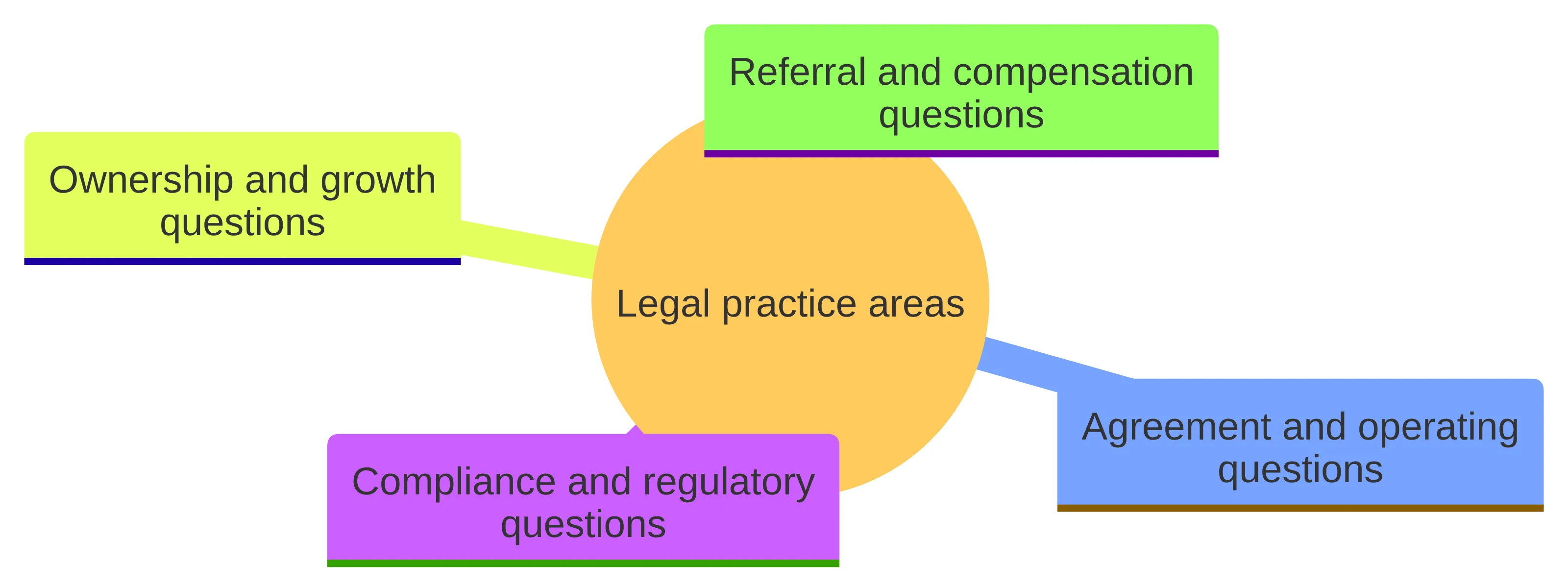
Organize the facts into the subject that needs discussion:
- Compliance and regulatory questions: Identify the healthcare laws, regulations, operational risks, or compliance concerns connected to the event.
- Agreement and operating questions: Note contracts, vendors, leases, staffing, patient policies, or new services involved in the decision.
- Ownership and growth questions: Identify whether the issue concerns ownership, practice growth, or a business decision requiring legal input.
- Referral and compensation questions: When healthcare referrals and compensation are involved, including some marketing fees and financial arrangements, record those facts as a topic for case-specific review because the anti-kickback statute may apply.
These categories help describe the consultation without deciding that a law applies, that conduct is compliant, or that a particular firm handles the matter.
A useful problem statement separates what happened from what you need counsel to assess. One sentence can state the operational event: “Our practice is considering a vendor agreement that affects clinical operations.” A second can state the question: “We need to understand the legal issues, the relevant jurisdiction, and the scope of review to discuss with counsel.”
Then identify the relationship you may need. A defined document review, a response to a particular operational question, and continuing outside-general-counsel support call for different conversations. Healthcare counsel may help review agreements, manage operational legal risk, evaluate new services, coordinate compliance issues, and support legally informed business decisions. Describe the work to be discussed rather than assuming a result or labeling the conduct before consultation.
A healthcare organization can face several legal lanes at once, so separate the immediate question from the surrounding business context. A vendor agreement may call for contract review even when the vendor supports clinical operations. A proposed referral arrangement may call for a compliance-focused discussion because referrals and compensation can raise anti-kickback questions. A planned expansion may involve ownership, new services, contracts, and ongoing operational guidance.
Write the immediate decision first, then list the related facts underneath it. This gives you practical search terms without pretending that the labels answer the legal question. If the issue involves referrals, compensation, or marketing fees, include those words in your consultation summary and ask counsel to evaluate the arrangement before you rely on a general description of the practice area.
Map the facts to the jurisdictions the consultation must cover
Make jurisdiction a required part of the consultation handoff rather than a late-stage location detail. Write down the state or states connected to the facility, organization, agreement, or disputed conduct. A facility in Austin may raise different jurisdiction questions from one in Beaumont; an organization operating across Abilene and Brownsville may need to explain how the matter crosses state or local boundaries.
ABA Model Rule 5.5 describes circumstances in which an attorney admitted in another U.S. jurisdiction and not disbarred or suspended may provide legal services temporarily elsewhere. State-specific rules and conditions still matter. The rule also addresses whether services are reasonably related to a jurisdiction where the lawyer is admitted and notes that some matters may require pro hac vice admission. Use those points to frame questions for counsel, not as permission to assume an attorney can handle your matter.
A multistate organization should record where each relevant fact sits rather than using its headquarters as the only location. List the facility, contract, professional relationship, or conduct connected to the question, then note the states that may matter. Take that list into the consultation and ask how the attorney’s admission and the nature of the work affect the proposed engagement.
A local office can be convenient for meetings, but convenience does not answer the authorization issue. An attorney admitted elsewhere may be able to provide some services under the circumstances described by ABA Model Rule 5.5, while another matter may require different authorization. Keep the geographic screen open until the jurisdiction question has a clear answer.
Use a directory to assemble a jurisdiction handoff
Lawyers.co can provide candidate material for the jurisdiction-and-consultation handoff, but it should not be treated as the decision method. Profiles and client reviews can help identify a stated practice area, location, experience question, or topic to raise. Clients can also use the platform to schedule consultations with lawyers.
Keep those directory signals separate from questions that require a direct discussion about the relevant jurisdiction, engagement scope, and fit. The useful output is not a completed conclusion about a firm; it is a focused set of questions and information for the consultation.
A jurisdiction-and-handoff record can organize several candidates without turning profile information into a ranking. For each candidate, note the practice area described, the healthcare work mentioned, the location, the state or states connected to the matter, the experience question, and the proposed type of engagement. Keep unanswered points marked as questions rather than filling them with an assumption.
The record should also separate an operational summary from documents and details that may need careful handling. In an initial contact, describe the issue at the level needed to explain the consultation and ask what information the attorney needs before reviewing materials. Do not assume that a rating, profile, or first exchange settles confidentiality, authorization, or suitability. Those points belong in the conversation with prospective counsel.
Test jurisdiction and engagement scope before choosing counsel
Healthcare experience is useful only when it connects to the issue and jurisdiction in the handoff. Some healthcare legal practices advise providers about the laws, regulations, risks, and market pressures affecting healthcare delivery, financing, compliance, and regulation. Ask which parts of that work resemble the operational question your organization is bringing to the consultation.
If the concern involves an agreement, vendor, lease, staffing matter, patient policy, ownership question, or new service, ask whether the attorney handles that type of work for healthcare practices. If questions will continue over time, ask whether the proposed relationship is structured as outside-general-counsel support. Healthcare practices may seek that type of ongoing support for contracts, staffing, patient policies, vendors, leases, compliance, ownership, and growth.
Use the consultation to test the open fields in the handoff rather than asking for a conclusion before the engagement is understood. Questions can include:
- Which state or states would you expect this consultation to address?
- What experience do you have with healthcare matters resembling the operational question?
- How would you define the work included in the proposed engagement?
- Would you view this as a defined project or continuing support?
- What information or documents would you need before discussing the issue?
- What fee structure should we discuss before deciding whether to proceed?
The answers help compare service fit, jurisdictional scope, and the next conversation without assuming that a broad healthcare description includes every type of legal work the organization may need.
The proposed service relationship should match the way the legal question will develop. A single agreement review may call for a defined document set and a specific question. A practice dealing with recurring contracts, staffing, vendors, patient policies, compliance, ownership, or growth may need to ask about continuing outside-general-counsel support instead. Those descriptions identify topics to discuss; they do not establish that a particular arrangement is suitable.
Ask how the candidate would distinguish included work from a new matter. Ask who would handle follow-up questions and what information the attorney would need before giving advice. Clear answers help you compare service fit without assuming that a broad healthcare description includes every type of legal work your organization may need.
Turn profile signals into consultation questions
Read a profile as a list of points to clarify, not as a completed assessment. Compare the attorney’s stated experience, client reviews, areas of specialization, location, and described healthcare work with the jurisdiction-and-consultation record.
For each profile, ask:
- Does the stated work relate to the operational question?
- Which state or states does the profile appear to connect to the matter?
- What experience needs a concrete example or explanation?
- Which review themes belong on the consultation agenda?
- What remains unknown about engagement scope or the information needed?
This comparison keeps directory signals in their proper role: they help shape a direct discussion about authority, experience, confidentiality questions, and service fit rather than supplying a final conclusion.
A review may help you ask about communication, the type of work performed, or how the engagement was handled. It cannot determine whether the attorney understands your organization’s facts, can act in the relevant jurisdiction, or will produce a particular result.
Do not rank candidates solely by a rating or by the number of reviews. Compare the signals that relate to your stated need, then take unresolved questions to the attorney. We provide profiles, client reviews, and a way to schedule consultations; your case-specific decision still requires a direct discussion with qualified counsel.
Add review-based questions to the handoff. If several comments mention communication, ask how updates and urgent questions are handled. If a profile describes a practice area without explaining the type of healthcare work, ask which matters resemble yours. If the location is broad, ask where the attorney is authorized to work on the relevant matter.
Keep the record focused on what needs clarification. A question raised by a review belongs in the consultation agenda; a conclusion about the attorney’s likely result does not.
Assemble a confidentiality-aware consultation handoff
The consultation handoff should explain the operational problem without trying to write the legal answer in advance. Prepare:
- A short description of what happened or what decision is pending.
- The healthcare operation, facility, agreement, or relationship involved.
- A brief chronology of relevant events and the people or organizations involved.
- The states connected to the facility, agreement, relationship, or conduct.
- The documents that best show the question, such as an agreement, notice, policy, proposal, or correspondence.
- Your practical goals, concerns, and decisions that may depend on legal guidance.
- Questions covering similar experience, approach, scope, and fee structure.
During a consultation, explain your situation and legal needs, bring relevant documents, and be candid about your goals and concerns. Organize the handoff so facts remain distinct from assumptions and questions remain distinct from conclusions.
Confidentiality needs its own question. Privilege can depend on who is communicating and the purpose of the communication. Communications with in-house counsel may face greater difficulty when they concern nonlegal business matters. For in-house-counsel communications, the parties may need to show that the purpose was predominantly legal rather than a business, public-relations, advertising, or other nonlegal purpose.
Before sending a large internal file, identify why each document matters to the legal question and ask the prospective attorney how the materials should be provided. Keep the packet focused on the issue you want evaluated, and make the distinction between legal questions and business objectives clear during the consultation.
A staged packet is easier to explain than an unfiltered archive. Start with the short issue summary, chronology, key document, and question list. Keep supporting material organized by topic so you can explain its connection to the legal question. If a document contains operational, marketing, or other business material mixed with a legal issue, identify that distinction before sending it and ask how the attorney wants to receive it.
The packet should prepare the consultation, not substitute for it. Give the attorney enough context to understand the question, then leave room for follow-up requests about facts, documents, goals, and concerns.
Use the consultation to test fit and urgency
The consultation should answer whether the candidate is a sensible match for the work you need discussed. Explain the situation and legal needs in a clear order, provide the relevant documents, and state your goals and concerns. Then ask:
- What experience do you have with similar healthcare matters?
- How would you approach the issue based on the information available today?
- What additional facts or documents would you need before advising us?
- What work would the engagement cover, and what would fall outside that scope?
- What fee structure should we understand before making a decision?
These questions let you compare the substance and clarity of the conversations without asking for a predicted result. Prepare the questions before the appointment so the discussion does not become a general description of the organization.
Let the legal question, not the convenience of continued searching, determine when you move to consultation. If a proposed referral, compensation arrangement, or marketing fee could affect how healthcare services are promoted or paid for, ask counsel to evaluate it before treating the arrangement as routine. The anti-kickback statute may apply when healthcare referrals and compensation are involved, including in some marketing fees and financial arrangements.
A similar boundary applies when the answer could determine an immediate operational decision. Stop expanding your shortlist and arrange a focused consultation when you need case-specific judgment about what your organization should do. General information can help you frame the question; it cannot resolve the facts, jurisdiction, or legal consequences of your particular situation.
After each consultation, record the answers while the conversation is fresh. Note the candidate’s relevant experience, stated approach, proposed scope, additional information requested, jurisdiction response, and fee-structure questions that remain open. Record whether the conversation addressed the issue you described or shifted to a different type of work.
Use the record to compare fit and identify the next question, not to predict the outcome of the matter. If the candidate cannot address the relevant practice area, jurisdiction, or service relationship, keep searching. If the conversation addresses those points and the remaining uncertainty is case-specific, use the attorney’s proposed next step to decide whether to continue.
Choose the next defensible action
Your next action should match the amount of uncertainty that remains:
- If the practice area and jurisdiction are still unclear: refine the problem statement and search terms before comparing firms.
- If you have several plausible candidates: review profiles, experience, specialization, reviews, and location using the same notes, then verify licensing and good standing.
- If one or two candidates fit the issue and jurisdiction: prepare your questions and documents, then schedule a consultation.
- If the matter involves a referral or compensation arrangement, a material operational decision, or facts that require legal judgment: move to a qualified attorney rather than relying on directory signals.
Profile information and reviews can support the search and handoff but do not guarantee a favorable result or replace case-specific legal review.
Use general information to prepare a better conversation, not to decide individual suitability on your own. A qualified attorney must assess your facts, jurisdiction, timing, and legal needs before advising you about a particular matter. Once you have identified the relevant lane and a candidate whose location and experience warrant further discussion, take the focused next step rather than treating a profile or review as the decision.
What should a healthcare administrator verify before contacting a nearby firm?
How can I identify the relevant legal practice area before searching for a lawyer?
Start by describing the operational problem in plain language. This will help you translate the issue into specific practice areas, such as compliance, contracts, or ownership, which can guide your search for legal assistance.
What criteria should I use when screening legal firms?
Consider location, relevant healthcare experience, service fit, and client reviews. Verify that the attorneys are licensed and in good standing with their state bar associations before proceeding.
How should I prepare for a consultation with a lawyer?
Prepare a focused packet that includes a description of your issue, relevant documents, a chronology of events, and a list of questions regarding the attorney's experience, approach, and fee structure.
What should I do if I need urgent legal advice?
If your situation involves immediate operational decisions or compliance issues, prioritize scheduling a consultation with a qualified attorney rather than continuing to search for options.
What steps should I take if I find multiple potential attorneys?
Review their profiles and experiences, compare their practice areas and client feedback, and verify their licensing status. Narrow down your options based on these criteria before scheduling consultations.
When should I escalate my legal questions to a qualified attorney?
Escalate your questions when they involve complex legal issues, potential liabilities, or when you need specific legal advice that cannot be addressed through general information.
Sources
- How to Ask a Lawyer for Free Advice Online: A Step-by-Step Guide — blog.lawyers.co, 2026-07-05
- Find the Right Pool Lawyer: A Step-by-Step Guide — blog.lawyers.co, 2026-07-06
- Health Care Operations & Compliance, Professional Perspective - Compliance Investigations: Privilege & Process — www.bloomberglaw.com
- Healthcare Compliance Law Firm | Oberheiden P.C. — federal-lawyer.com, 2023-05-24
- Healthcare Attorneys | Falcon Rappaport & Berkman — frblaw.com
- Healthcare Care Law and Practice Counsel — www.seddiqlawfirm.com
- Rule 5.5: Unauthorized Practice of Law; Multijurisdictional Practice of Law — www.americanbar.org